Bubble Shooter Gem Puzzle Pop
- 4.8
- Rating
- 10.00M
- Installs
- Free
- Price

 Analysis by App-foxy
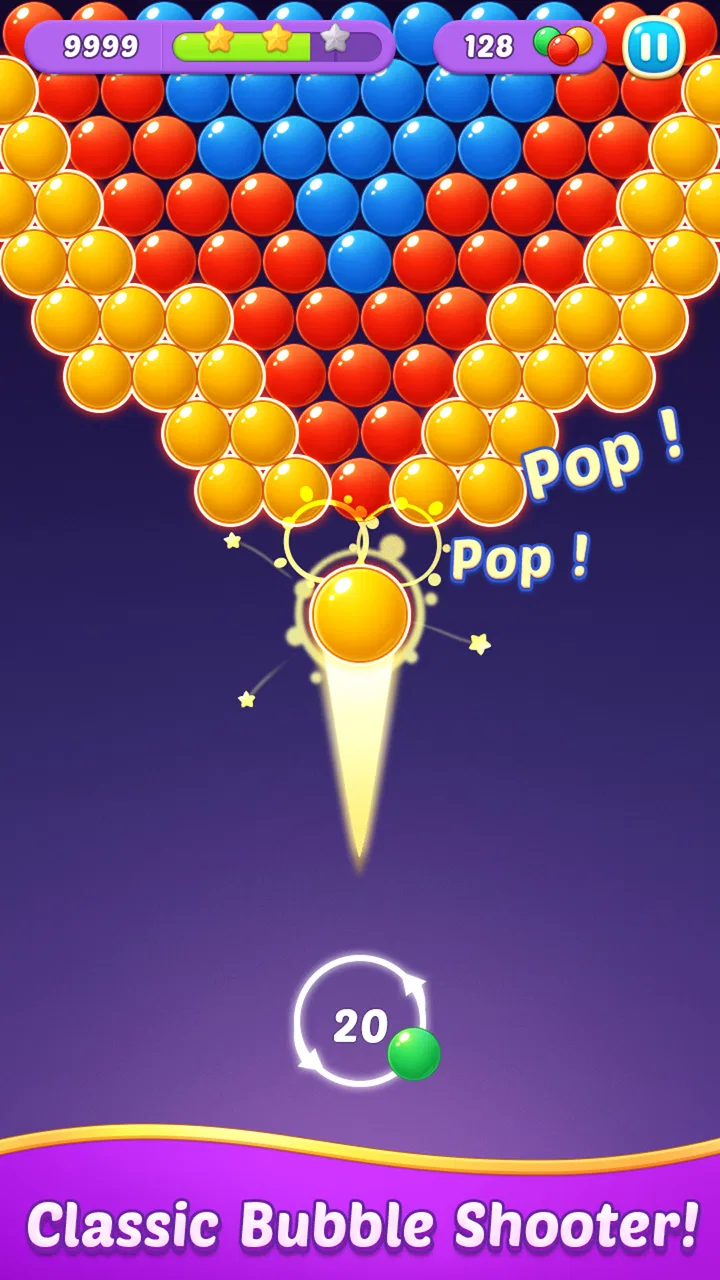
I spent time with Bubble Shooter Gem Puzzle Pop because its central appeal is easy to understand: aim, match, and clear bubbles before the board becomes too difficult to manage. That sounds familiar, but the important part is how this simple capability changes the pace of a short play session. Instead of asking me to learn a complicated control scheme or follow a long story, it gives me a compact puzzle problem and lets me decide whether to play carefully or take a quick chance.
This is a casual game from Lynn Mobile Puzzle Games, available for free and suitable for Everyone. It has reached more than ten million installs and holds an average rating of 4.8 from roughly thirty-three thousand ratings, so it clearly appeals to a broad audience. I can see why: the basic idea is approachable within seconds, yet the better levels make me think about angles, order, and when to stop chasing an attractive shot.
Why the bubble-clearing ability matters
The main capability here is not simply shooting bubbles. It is the ability to turn a crowded arrangement into a sequence of small decisions. I look at the colors and positions, identify a useful connection, then choose whether the immediate match is more valuable than setting up a better move. That makes each shot feel like part of a short plan rather than an isolated tap.
You May Also Like

 Blood Strike: 2.5 Anniversary
Blood Strike’s Loadouts Turn Every Drop Into a Tactical Gamble
A close look at Blood Strike’s custom loadouts: how fast access to signature weapons reshapes its battle royale rhythm, rewards preparation, and narrows the gap between fights.

 Pandora - Music & Podcasts
Pandora’s Music Is Easy to Start, but Harder to Recover
Pandora’s strength is its low-effort path from a seed to a station. Its weak spot is how much confidence it asks you to place in connection, setup, and quiet recovery.

 8 Ball Pool
 Is Built on Rivalries, Rematches, and Routine
A close look at the rivalries, rematches, shared routines, and unanswered safety questions that turn a quick pool match into a persistent mobile community.

 Samsung Music
’s Quiet Strength Is Playing What You Already Own
Its reach comes less from spectacle than from dependable access to a personal library. That simplicity is both the app’s strongest retention engine and its ceiling.

 AccuWeather: Weather Radar
AccuWeather Review: A Quick, Clear Forecast for Everyday Decisions
For everyday plans, the best forecast is the one you can understand quickly. AccuWeather makes rain timing, radar, and local conditions easy to act on, with a few trade-offs.

 Hill Climb Racing
Why Hill Climb Racing Still Turns Crashes Into One More Run
A tiny car, a bumpy hill and one more upgrade: Hill Climb Racing keeps resurfacing because its simple chaos makes every near-miss feel personal.
More From Our News Desk



In practice, this is what separates the game from a purely reflex-based time filler. I can play slowly and inspect the board, which is helpful when a cluster is suspended from a narrow connection. A careless shot may remove a few bubbles but leave the larger structure intact. A better angle can reach a supporting group and cause a much more satisfying clear. The game’s strongest moments come from recognizing that the obvious target is not always the useful target.
The controls are familiar enough for almost anyone who has played a bubble shooter. I guide the launcher, adjust the direction, and release when the line looks right. That low barrier is valuable on a phone because I do not have to remember complicated gestures. It also means the game works well for short sessions when I am waiting for transport, taking a break, or winding down before bed.
What I appreciate most is the way the basic action creates a quiet planning loop. I am not just asking, “Can I hit that color?” I am asking, “What will remain after I hit it?” That question becomes increasingly important when a direct path is blocked or when removing one group changes the shape of the board. The real strength is the decision between a quick match and a better setup.
How a normal level feels in practice
I usually begin by scanning the whole arrangement rather than firing immediately. The first few seconds are enough to spot exposed groups, hanging sections, and awkward colors that may become harder to reach later. This small pause improves my results more than rushing through several weak shots. It is also a useful habit for new players, because the game rewards observation without requiring a tutorial-heavy approach.
When a clear shot is available, I consider whether it opens the board or merely reduces its surface. A shot that removes a small group near the edge may look successful, but it can leave the central structure untouched. By contrast, a less obvious banked angle may connect with a supporting cluster and remove more of the arrangement. I do not need advanced mathematical precision, but I do need to think about the route the bubble will take.
The most practical technique is to treat the walls as part of the aiming system. Instead of trying to reach every target directly, I look for a rebound path when the front of the board is crowded. This is especially useful when a matching group sits behind another color. I aim for the side, let the shot change direction, and try to reach the protected area from behind. It is a small adjustment, but it gives the game more depth than a simple straight-line shooter.
I also learned not to spend every useful color as soon as it appears. If a matching opportunity is small and safe, taking it may be reasonable. But if the same color could later connect a much larger group, holding back can be the better choice. This creates a trade-off between immediate progress and future flexibility. The game does not need complicated equipment or character abilities to create that tension; the board itself is enough.
Another helpful approach is to clear unstable sections before they become isolated. A group supported by only a few bubbles can sometimes be removed indirectly, but leaving it until the board becomes crowded makes the angle harder. I try to notice these weak links early. This is one of the less obvious lessons of the game: the best move is often about removing support, not matching the largest visible cluster.
A useful game for small gaps in the day
The best everyday scenario for me is a short waiting period. If I have ten minutes before an appointment, I can start a level without committing to a long campaign or a complicated story segment. The controls are simple enough to use one-handed, while the puzzle structure gives the time a little more purpose than endlessly scrolling through a feed.
It also works as a gentle break between demanding tasks. After concentrating on writing or work, I may not want another game that requires fast reactions, detailed planning across a large map, or constant attention to several systems. Here, I can focus on one board at a time. The act of lining up a shot gives me something concrete to do, while the casual format keeps the mental load manageable.
That does not mean every session feels equally relaxing. A difficult arrangement can make me replay a level mentally after a failed attempt, especially when I know a different angle might have solved it. For some people, that is the fun part. For others, it may turn a supposedly relaxing game into a source of mild frustration. I would describe the experience as calm when I play casually, but more demanding when I start chasing perfect decisions.
Families may also find the game approachable because the age rating is Everyone and the basic interaction is easy to explain. A parent can show a child how matching works, while an older player can focus on planning shots and managing limited opportunities. I would still recommend that adults keep an eye on spending settings, since the free download includes in-app purchases ranging from $0.99 to $79.99 per item.
Where the free model changes the experience
The free entry point is a major advantage. I can install the game and understand whether its rhythm suits me without paying first. That matters in a crowded casual category, where many bubble shooters share similar controls. The absence of an upfront price makes experimentation easy, particularly for someone who wants a simple game rather than a large premium purchase.
At the same time, free-to-play design can affect how comfortable a long session feels. The listed purchase range is wide, so I would not treat the game as completely cost-free in the broader sense. A player who wants to avoid accidental spending should review the device’s purchase protections before handing the phone to a child or leaving the game open during shared play.
I also think the game is better suited to people who enjoy repeated puzzle attempts than to players looking for a deep progression system. Its appeal comes from the board, the shot, and the satisfaction of clearing a difficult arrangement. If you need a strong narrative, a large collection of characters, or a competitive multiplayer focus, this will probably feel limited beside those alternatives.
Compared with classic match-three games, the difference is the importance of trajectory. In a match-three title, I usually manipulate pieces directly and think about adjacent combinations. Here, I think in terms of angles, rebounds, support, and the order in which groups should disappear. Compared with fast arcade games, the pace is more deliberate. Compared with premium puzzle games, the free format is easier to try but may be less appealing to someone who wants a tightly controlled, purchase-free experience.
The game’s limitations are closely tied to its simplicity. The straightforward controls are welcoming, but they do not provide much variety outside the bubble-shooting loop. Players who become bored with repeating the same fundamental action may not stay interested, even if the individual puzzles become trickier. I would also skip it if I specifically want a game that can be played without thinking at all; the better results come from paying attention to the board.
Who benefits most from this design
I think the strongest audience is someone who wants a familiar casual puzzle with enough planning to prevent it from feeling automatic. It suits players who enjoy improving through observation: noticing a better rebound, recognizing a weak connection, or learning to delay a tempting match. It is also a good fit for people who prefer short sessions and do not want to memorize a large set of rules.
It may be especially useful for anyone who likes to alternate between relaxed and focused play. I can fire a few simple shots when I only have a moment, then slow down when a board deserves more thought. That flexibility is more valuable than it first appears. Many mobile games force a choice between complete passivity and intense concentration; this one sits comfortably between the two.
New players should begin by looking for the board’s support points rather than chasing the biggest color group. Try a direct shot when it opens space, but consider a wall rebound when the target is hidden. Before releasing, ask whether the shot improves the next turn as well as the current one. These habits make the puzzle feel more understandable and reduce the frustration of shots that technically match but leave the board in a worse position.
Experienced bubble-shooter players may appreciate the cleaner focus, although they should not expect the same depth as a more elaborate puzzle package. The game’s value is in its accessibility and quick decision-making, not in adding a long list of systems. That makes it easy to recommend to a friend who wants a casual time killer, but I would be more cautious with someone who has already exhausted this exact shooting format.
Device fit and day-to-day practicality
The game requires Android 6.0 or later, which makes it accessible on a wide range of Android devices that are still in everyday use. Its current version is 1.8.0.4, and the simple interaction makes it feel appropriate for a phone rather than something that needs a large screen or specialized controls. I would choose a larger display if I wanted to inspect angles carefully, but the core play remains understandable on a typical handset.
Because the experience is built around individual shots, interruptions are less disruptive than they would be in a real-time action game. I can put the phone down between decisions and return to the board without feeling that I have missed a fast event. That makes it practical for casual use, although anyone who becomes invested in solving a difficult level may still prefer to play when they have a quiet few minutes.
The game’s popularity gives it a reassuring first impression: more than ten million installs and a 4.8 average from around thirty-three thousand ratings suggest that the basic format has connected with many players. I do not take popularity as proof that every player will enjoy it, but it does match my experience of a polished, immediately understandable casual puzzle rather than an obscure experiment.
My recommendation after playing
I recommend Bubble Shooter Gem Puzzle Pop to anyone who likes bubble matching but wants a little more thought behind each shot. Its strongest verified capability is the puzzle-focused shooting itself, and that capability works because angles and timing turn a basic match into a small tactical decision. I found the game most enjoyable when I stopped treating every available match as an instruction and started considering what the board would look like afterward.
It is not the right choice for players seeking a story-driven adventure, elaborate competitive features, or a fully premium experience with no purchase temptation. The free model deserves sensible spending controls, and the repeated core loop may eventually feel narrow for people who need constant novelty. Those are fair limitations, not reasons to dismiss the game.
For short breaks, casual family play, and anyone who enjoys improving through better positioning, this is an easy game to keep installed. Lynn Mobile Puzzle Games has focused on a familiar idea and given it enough tactical texture to make individual decisions matter. If you enjoy turning one careful shot into a much larger clear, this is a free casual game worth trying.
FAQs for Bubble Shooter Gem Puzzle Pop
01What is Bubble Shooter Gem Puzzle Pop about?
Bubble Shooter Gem Puzzle Pop is a captivating puzzle game where players aim and shoot colored bubbles to create matches and clear levels. It combines traditional bubble-shooting mechanics with engaging challenges and vibrant graphics, making it suitable for casual gamers looking for a fun and relaxing experience.
02Is Bubble Shooter Gem Puzzle Pop free to play?
Yes, Bubble Shooter Gem Puzzle Pop is free to download and play. However, it offers in-app purchases for items like extra lives, power-ups, and ad removal. These purchases are optional and players can enjoy the game without spending money, though they may enrich the gaming experience.
03What platforms is Bubble Shooter Gem Puzzle Pop available on?
Bubble Shooter Gem Puzzle Pop is available on both Android and iOS platforms. Players can download it from the Google Play Store for Android devices and the Apple App Store for iOS devices, ensuring access to a wide range of mobile users.
04Does Bubble Shooter Gem Puzzle Pop require an internet connection?
Bubble Shooter Gem Puzzle Pop can be played offline, allowing players to enjoy the game without an internet connection. However, some features, such as in-app purchases and certain updates, may require an active internet connection to function properly.
05Are there any ads in Bubble Shooter Gem Puzzle Pop?
Yes, Bubble Shooter Gem Puzzle Pop contains ads that appear between levels or after certain actions. Players can remove ads by making an in-app purchase. This ad-supported model helps keep the game free for all users while offering an ad-free experience for those who prefer it.
Pros
- Addictive gameplay keeps users engaged.
- Vibrant graphics enhance visual appeal.
- Smooth performance with minimal lag.
- Frequent updates with new levels.
- Easy to learn for all age groups.
Cons
- In-app purchases can be costly.
- Ads can interrupt gameplay.
- Limited offline functionality.
- Battery consumption is high.
- Some levels feel repetitive.

Bubble Shooter Gem Puzzle Pop
Gallery